VI

Parking sensors | Why smart systems use different types
Parking sensors help a system detect vehicles, people and equipment status. Detecting a vehicle and confirming a pallet’s position are different tasks. Understanding how sensors cooperate helps project owners assess configurations and operating alerts.

Why is one sensor type insufficient for the entire system?
An automated parking system must answer several questions before moving a vehicle. Is it positioned correctly? Are its dimensions suitable? Has the user left the machinery area? Has the pallet reached its stop, and is its lock in the required state? Each question requires different information. A vehicle-presence sensor does not necessarily measure height. A pallet-position sensor does not automatically detect people in a movement zone. Different tasks therefore require a combination of sensors suited to the installation.
Detection targets also differ. Metal, vehicle bodies, people and small objects have different characteristics. Distance, viewing angle, lighting, dust and water affect results. Designers must choose suitable detection principles rather than use one device everywhere.
Project owners should understand that sensor quantities follow the conditions the system must check. Configurations with more movements, transfer points and accessible areas usually require more signals.
What do different parking sensor groups check?
Grouping sensors by function makes them easier to understand. The categories below describe common tasks, not a mandatory list for every site. Depending on the design, one function may use several technologies, while one device may provide several types of data.
| Function group | Information required | Operational value |
|---|---|---|
| Vehicle detection | Whether a vehicle is at the reception point, lane or parking position | Confirms vehicle presence before the next step |
| Vehicle dimension checks | Whether the vehicle exceeds designed height, width or length limits | Helps prevent acceptance of vehicles unsuitable for the transfer space |
| Parking-position checks | Whether the vehicle is inside the permitted pallet or reception area | Helps prevent movement when a vehicle is misaligned or protrudes |
| Person and obstacle detection | Whether an object is in the monitored area | Provides signals for appropriate warnings or protective functions |
| Position and travel detection | Where the pallet, lift or transfer device has reached | Supports stopping and handover at the correct point |
| Door and lock monitoring | Whether doors, pins or locks are in the required state | Allows the controller to check interlock conditions |
| Load or mechanism abnormality monitoring | Whether load or mechanism status is within permitted limits | Supports abnormality detection where this function is included |
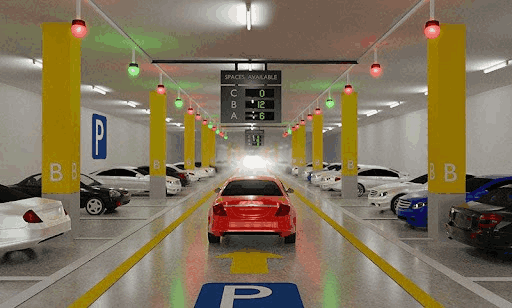
In conventional facilities, sensors may also support occupancy reporting and barrier control. Detecting an occupied space differs from monitoring a lifting machine’s movement zone. These applications should not be treated as equivalent when assessing a configuration.
How do parking sensors cooperate during a parking cycle?
Sensors do more than issue standalone alerts. They send information to the controller so it can determine which steps are permitted. In a typical cycle, the system detects a vehicle at reception and checks its conditions. It confirms machinery-area status before permitting movement. At the transfer point, it checks pallet or transfer-device position signals and mechanism status again. The exact sequence depends on the system design.
| Stage | Condition to check | Meaning of the signal |
|---|---|---|
| Vehicle reception | Vehicle has reached the designated position | The system can begin checking the vehicle |
| Vehicle checks | Suitable dimensions and parking position | Vehicle meets acceptance conditions |
| Preparation for movement | Machinery area, doors and related mechanisms meet required conditions | The controller can permit the cycle to continue |
| Lifting or transfer | Position and movement status are monitored | Equipment follows the designed sequence |
| Vehicle handover | Mechanisms reach the correct positions and states | The transfer step is permitted |
| Cycle completion | Vehicle and equipment status are confirmed | The result is updated and the system prepares for the next cycle |
Illustrative example: A vehicle is on the pallet, but a mirror or accessory protrudes beyond the permitted area. The presence sensor may already confirm the vehicle, while the boundary check is not satisfied. Preventing lifting is an appropriate response to this monitored condition.
A parking command therefore does not always trigger immediate movement. The controller still has to check the relevant conditions.

How do measuring sensors differ from safety sensors?
Measuring sensors provide distance, position or dimension information. Sensors used in safety functions must meet the system’s defined protective requirements. Devices that look similar or both use lasers are not necessarily interchangeable. Assess intended use, fault detection, interfaces and controller integration. Placing a distance sensor near movement does not make it a person-protection device.
For example, distance data can help a shuttle find its stopping point. Monitoring people around a robot needs protective coverage suited to its direction and speed. These are different tasks even if both use optical technology.
Sensors also do not replace all protective mechanisms. Anti-fall locks, brakes, protective doors and emergency stops have separate roles. A sensor may monitor a mechanism, but load retention still depends on the mechanical device designed for it.
A useful assessment for project owners asks what the device detects and how the system responds, rather than simply reading a technology name on a quotation.
See also: XIZI parking fence height | Why XIZI chose 1,100 mm for its puzzle parking fences and what to check at handover.
Why do puzzle, tower and robotic systems need different configurations?
Each system has different movement paths and contact points. Puzzle systems coordinate lifting and sliding pallets within a mechanical assembly. Tower systems also determine lift positions, parking levels and transfer-point status. Vehicle-carrying robots handle positioning, vehicle reception and monitoring their travel space. Sensor configurations must follow the actual mechanisms.
| System type | Monitoring focus | Reason for a specific configuration |
|---|---|---|
| Puzzle parking | Pallet positions, travel limits and access-area status | Pallets must lift or slide in the appropriate sequence |
| Tower parking | Lift position, parking level and transfer-point status | Vehicles pass through multiple positions vertically |
| Horizontal transfer with a shuttle | Transfer-device position and handover conditions | Horizontal movement must be coordinated with lifts or storage spaces |
| AGV robots | Positioning, vehicle characteristics and travel zones | Robots move through space and must respond to surrounding objects |
Even within one system category, layout and operating arrangements may change the configuration. Indoor and outdoor sites have different conditions. User-accessible areas also affect the monitoring design.
See also: Puzzle parking systems.
Do more sensors necessarily mean greater safety?
Quantity alone cannot establish safety. A badly positioned sensor may miss a required detection zone. A valid signal can still produce an unsuitable response if control logic is wrong. Effectiveness depends on coverage, operating conditions, reliable signals and the entire sensor-to-actuator chain.
Distinguish supplementary checks from redundancy. Two sensors watching one area may check different conditions. Identical devices do not automatically demonstrate safety redundancy: both may fail together because of the same obstruction, mounting position or power supply.
Conversely, removing sensors only to reduce costs may eliminate a necessary check. Ask providers to explain configuration differences in terms of movements, monitored areas and system responses.
A suitable configuration addresses actual site scenarios and remains testable and maintainable during use.
How should operators interpret sensor alerts?
An alert may indicate an unmet condition or an object being detected. It can also result from device or signal-path faults. Distinguish these causes before acting. A vehicle-position warning may result from misalignment or a protruding accessory. An obstructed sensor may also trigger it. Prevented movement alone does not prove sensor failure.
Useful information includes the alert code, location, cycle stage and observed conditions. It helps technicians define an inspection scope instead of replacing devices on assumptions.
Illustrative example: A position alert repeatedly appears after reception-area cleaning. Staff record the time and code so technicians can inspect the sensor head, obstructions and mounting. Establish the cause before adjustment or replacement.
Bypassing signals or independently changing thresholds may alter conditions for permitted movement. Such work must follow manufacturer instructions and the authorized technical scope.
How does sensor maintenance affect operations?
Parking sensors need suitable operating conditions. Dust or obstructions can affect optical paths and coverage. Misaligned mounts can shift measuring points. Wiring, connectors and power can cause signal loss or unstable alerts. Layout changes or objects placed near machinery can also affect detection.
Maintenance involves more than cleaning. The responsible provider must check mounts, wiring, signals and system responses according to technical instructions. After replacement, confirm model compatibility, configuration and relevant functions.
Intervals depend on device type, environment and operating frequency. Check manufacturer documentation rather than apply one schedule to every project.
Diagnostic and maintenance access add long-term value. Hard-to-reach devices or unclear alerts can make fault-finding take longer.

Frequently asked questions about parking sensors
Can one camera replace all sensors?
This cannot be assumed. A camera can identify vehicles or analyze images, but substitution must be assessed for each function. Plate reading is not equivalent to confirming a mechanical lock or protecting a movement zone.
Do all automated parking systems have the same sensor quantity?
No. Quantities and types depend on movement mechanisms, transfer points, accessible areas and design requirements. Assess the exact model and site.
Is an occupancy sensor a safety sensor?
These functions are not equivalent. An occupancy sensor determines whether a space is in use. Protecting people or controlling movement needs appropriately designed equipment and integration.
Does a sensor fault always stop the entire system?
The response depends on its function and control design. A fault may block one step or stop part of the system. Not all faults produce the same response.
Can a sensor be replaced by a model with similar specifications?
Check compatibility first. Besides range, consider signal type, response time, environment and functional requirements. Test the replacement within the system.
Viet Chao advises on suitable site-specific sensor configurations
With experience supplying and installing smart parking systems in Vietnam since 2009, Viet Chao implements lifting, puzzle, tower and vehicle-transfer solutions suited to each site. Review sensors alongside machinery, layout and operating procedures so devices perform their intended tasks together. When discussing smart parking, owners can provide expected vehicles, installation conditions and operating requirements for the technical team to assess an appropriate solution. Call 0898 55 28 88 for advice.
Other news

How many smart parking spaces can a 200 m² automated car park provide? Viet Chao often hears this question from clients seeking advice and planning construction. This example gives project owners a reference for the number of spaces, the system model and the expected cost. How many parking spaces can fit on a 200 m²…

Smart parking near metro stations is gaining attention as public transport networks in major cities expand. Once metro services begin operating, more passengers need to connect private vehicles with public transport. That creates demand for convenient, secure car parks that can be operated efficiently. Around stations, car parks give passengers somewhere to leave their vehicles…

Parking fence height affects how equipment, walkways and protected areas fit together. XIZI iParking recently announced a standard height of 1,100 mm for fixed fencing within the applicable range of its XIZI PSH puzzle parking systems. What does this change mean for the quality of the installation, and why did XIZI choose a new height?…

A sliding pallet parking system can use space in different ways depending on how its pallets move. XIZI offers a double-row PSH configuration that adds front-to-back movement to the horizontal and vertical movement of a standard puzzle parking system. This extra axis brings additional space and equipment requirements. Here is what project owners should consider…

Rooftop parking provides car parking spaces on a building’s roof, making additional space available to meet parking demand. With suitable design and integration with smart parking systems, this area can form part of the building’s traffic and operating plan. Effective implementation, however, requires project owners to address structure, access, parking technology and maintenance together. Explore…