VI

Parking POS terminals | Checks before operation
As shopping centres, hospitals, apartment complexes and office buildings expand, parking payments made by bank transfer via QR codes are increasingly revealing limitations. Staff must record times manually, fee calculations are prone to errors and vehicles may queue at exits during peak periods. Parking POS terminals help staff check vehicle information, calculate fees and record transactions at the control point. Connected to a smart parking system, the device also becomes part of a coordinated management process from entry to departure.
What is a parking POS terminal?
A parking POS terminal is a device used at parking facilities for one or more tasks, including:
- Looking up vehicle information.
- Checking entry and exit times.
- Calculating parking charges using configured tariffs.
- Accepting or confirming payments.
- Printing invoices or receipts.
- Recording transactions in management software.
- Helping staff open the gate for departing vehicles.
Depending on the operating model, the POS may be a fixed device in a control booth, a handheld staff device or a self-service terminal near the exit.
What work does a parking POS terminal actually perform?
A parking POS terminal (illustrated) is a handheld device combined with an application for recording visits and collecting fees. Its functions depend on compatible hardware, software and connectivity.
In iParking, visit data works with cameras, readers and barriers for gate verification. A POS is a mobile operating point, not a replacement for the entire system or a way to create extra parking spaces. At smart parking facilities with payment kiosks supplied and installed by Viet Chao, customers can retrieve their information and pay with a single touch.

See also: Cashless parking payment models | How they differ from staff-operated collection points.
Should smart parking facilities consider handheld POS payments?
Handheld POS devices are worth considering when vehicle owners cannot pay at a payment kiosk.
| Operating situation | Requirements for a handheld payment device | When to study a fixed system |
|---|---|---|
| Changing work locations | Data follows authorized users; connectivity and power suit the work location | Stable control points, cameras or coordinated barriers are needed |
| Multiple lanes operating simultaneously | Correctly identifies lanes, operators and transaction status across devices | Queues need lane-by-lane coordination to avoid processing the same visit on several devices |
| Fixed cameras required | Retrieves necessary evidence according to the integration design | Stable camera views are needed to compare vehicles and drivers at the gate |
| Customer self-payment required | Distinguishes staff-assisted operation from customer self-service | Consider kiosks with assistance points for customers encountering errors |
See also: Cashless parking | Choosing payment methods for a parking facility.
How does the process continue if the network fails or the battery runs out?
Local recording differs from online payment confirmation. The supplier must test which functions can continue without a connection. Data saved on one device does not prove another device can see the visit or that payment is complete. Test disconnection, restoration and reconciliation of pending visits. Define who decides to continue, stop or use an approved backup. If the battery runs out, hand over transaction status rather than recreate visits from memory. Power supplies and spare devices must suit site conditions. After recovery, check missing or duplicate visits and unconfirmed payments. Record test results in the handover file and appoint a responsible person so each shift does not make its own assumptions.
Frequently asked questions about parking POS terminals
Does a parking POS terminal automatically accept bank cards?
Not automatically. The device must support payment acceptance and connect to the relevant service provider. A parking-card reader does not automatically become a bank-card reader.
Can a retail POS terminal manage a parking facility?
It can serve as hardware if compatible with the parking management application and required accessories. Test visit recording, charging and reconciliation. Installing ordinary retail software does not demonstrate suitability.
Can vehicles still be accepted during a network outage?
Continue only with offline functions confirmed and tested by the supplier. Local visit recording may differ from payment confirmation or data sharing across devices, so specify reconciliation procedures after connectivity returns.
Is a ticket printed by a POS terminal an electronic invoice?
No. A paper ticket or receipt does not itself demonstrate that an electronic invoice has been issued. If this function is required, the operator must check the integrated software and invoicing service, rather than assume it from the presence of a printer.
Viet Chao provides complete smart parking consultation and installation
Viet Chao is a smart parking supply and installation contractor with more than 60 projects and over 6,000 smart parking spaces nationwide. Drawing on its experience as a leading industry provider, we advise on products suited to the budget, project and equipment within the overall operation of a smart parking facility. Project owners can submit lane diagrams, collection methods and shift-handover requirements for advice on suitable control arrangements, rather than choosing solely by device appearance. Contact our hotline on 0898 55 28 88 for further details.
Other news

How many smart parking spaces can a 200 m² automated car park provide? Viet Chao often hears this question from clients seeking advice and planning construction. This example gives project owners a reference for the number of spaces, the system model and the expected cost. How many parking spaces can fit on a 200 m²…
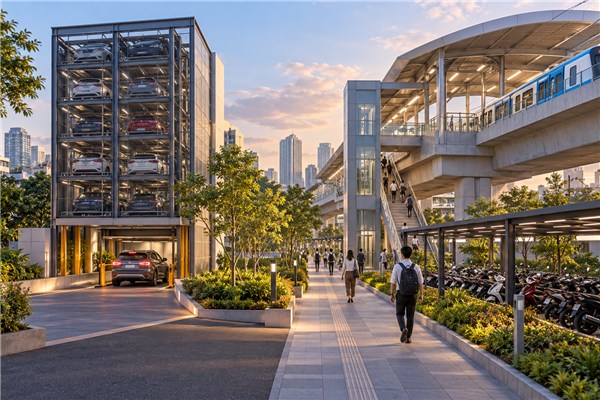
Smart parking near metro stations is gaining attention as public transport networks in major cities expand. Once metro services begin operating, more passengers need to connect private vehicles with public transport. That creates demand for convenient, secure car parks that can be operated efficiently. Around stations, car parks give passengers somewhere to leave their vehicles…

Parking fence height affects how equipment, walkways and protected areas fit together. XIZI iParking recently announced a standard height of 1,100 mm for fixed fencing within the applicable range of its XIZI PSH puzzle parking systems. What does this change mean for the quality of the installation, and why did XIZI choose a new height?…

A sliding pallet parking system can use space in different ways depending on how its pallets move. XIZI offers a double-row PSH configuration that adds front-to-back movement to the horizontal and vertical movement of a standard puzzle parking system. This extra axis brings additional space and equipment requirements. Here is what project owners should consider…

Rooftop parking provides car parking spaces on a building’s roof, making additional space available to meet parking demand. With suitable design and integration with smart parking systems, this area can form part of the building’s traffic and operating plan. Effective implementation, however, requires project owners to address structure, access, parking technology and maintenance together. Explore…